Summary
Most rent payment platforms in Singapore charge high fees of 1.9-2.6%, which can cost tenants over $1,000 a year and often wipe out any credit card rewards.
These platforms typically act as simple payment routers, limiting their services to processing transactions and offering only standard card rewards.
Key differentiators in the market include the availability of a 0% fee option, the ability to "dual stack" rewards, and offering financial flexibility like deposit financing.
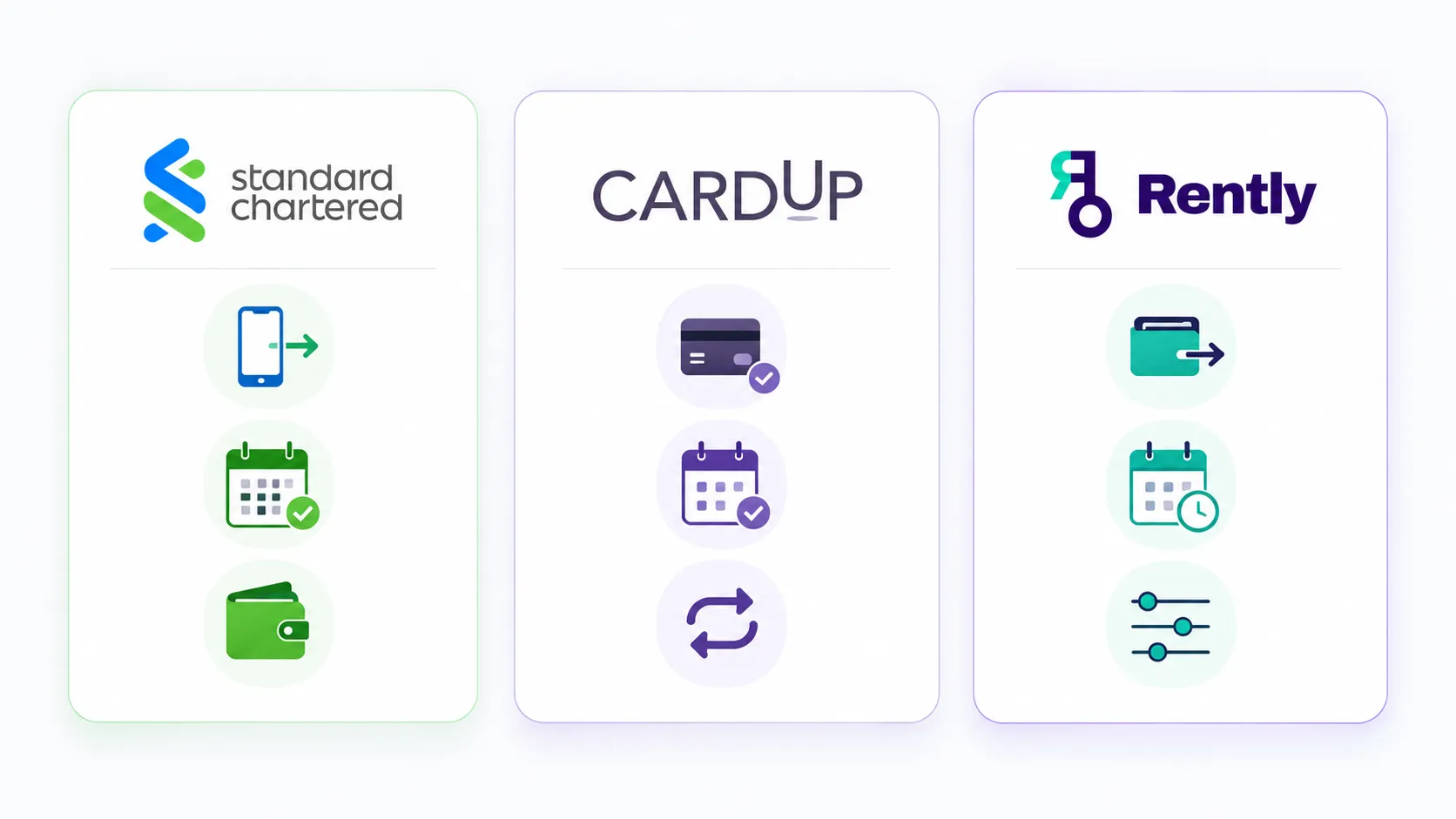
Rently is the only platform that offers all three: a 0% fee option, dual-stacking rewards, and unique services like deposit financing and rent deferral.
You've been paying rent the same way every month — a PayNow transfer, a bank transfer, maybe a standing instruction — and every time, you wonder: is there a smarter way to do this?
If you've spent any time on r/singaporefi, you already know the frustration. Tenants want to earn cashback or miles on their single biggest monthly expense, but the moment they look into it, they hit a wall of fees that wipe out the rewards entirely. As one redditor put it bluntly: "What we need is a way to pay rent without charges or at least offset with cashback."
In Singapore, Rently is leading the charge, alongside other platforms like SC EasyBill and CardUp. Each promises to help you get more out of your rent, but they work very differently, serve very different people, and the gap between them is wider than most comparisons let on.
Here's an honest breakdown — starting with the numbers, then walking through three real tenant scenarios, and finally explaining why two of these platforms are fundamentally limited by what they are.
Part 1: Which Platform Wins for Your Scenario?
Scenario 1: The SC Cardholder Maximising Bank Rewards
You: An existing Standard Chartered cardholder — maybe you have the SCB Visa Infinite or the Beyond Card — and your priority is squeezing maximum miles out of your SC card while keeping things simple.
SC EasyBill is the obvious first stop. At a 1.9% fee, a holder of the StanChart Beyond Card earns 2 mpd, translating to a cost of roughly 0.95 cents per mile — competitive by Singapore credit card standards. It's bank-native, so there's no third-party involved. The catch? SC EasyBill restricts you to one rental payment per month, doesn't support recurring automated payments, and the card must be an SC card.
CardUp accepts SC cards too, but its standard 2.6% fee makes the cost-per-mile considerably worse. Unless you catch a promo, it's hard to justify over EasyBill for pure SC card optimisation.
Rently, however, changes the maths. You can still pay with your SC card through Rently and earn your base card rewards. But here's the difference: for a small additional fee, you can simultaneously earn Rently's proprietary Max Miles on top — creating a dual reward stream from a single rent transaction. Rently also handles recurring payments automatically, so you're not logging in monthly just to submit a payment.
🏆 Verdict: Rently. The SC cardholder gets their native card miles plus a second layer of Max Miles, with full automation. SC EasyBill is the runner-up if you want a purely bank-native experience and don't mind the manual submission.
Scenario 2: The Miles Hacker Stacking Dual Rewards
You: You read MileLion religiously, you have strong opinions about the best credit card for overseas spend, and you view rent as 1,500–5,000 dollars of untapped monthly miles potential. You're in r/singaporefi asking how to maximize miles on rent.
For this persona, SC EasyBill and CardUp are fundamentally one-dimensional tools. They're payment portals. You pay a fee, your card earns its standard miles, and that's the ceiling. The transaction ends there. Whether you use a UOB PRVI Miles, a DBS Altitude, or any other miles card through these platforms, you're getting one reward stream: your card's native miles at the platform's fee rate.
Rently's Earn Rewards feature breaks that ceiling entirely. Here's how dual stacking works in practice:
Pay rent on Rently using your best miles credit card (e.g., UOB PRVI Miles at 1.4 mpd locally)
Simultaneously, earn Rently's proprietary Max Miles (powered by HeyMax) at 0.3 Max Miles per $1 on the credit card tier
Both reward streams hit at once — from a single rent payment
Max Miles are flexible: they transfer to KrisFlyer, Velocity, and yuu Points, and they never expire. The KrisFlyer transfer ratio runs at approximately 0.83:1, with 1:1 available on promo days.
For tenants who prefer not to use a credit card at all, the eGIRO Tier 1 option on Rently offers a standalone cost of just 1.33 cents per mile — competitive with many optimised credit card methods, and it works with any Singapore bank account. No specific card required.
SC EasyBill and CardUp have no equivalent. You are capped at whatever your credit card natively earns.
🏆 Verdict: Rently — and it's not close. Dual reward stacking on rent is structurally exclusive to Rently. For any serious miles hacker, this is the only platform worth considering.
Scenario 3: The Cash-Tight Tenant Needing 0% Fees
You: A young professional, a BTO-waiting couple, or anyone who needs to keep monthly expenses lean. You've looked at CardUp and immediately done the maths: 2.6% on $3,500 rent is $91 extra every single month. That's $1,092 a year, gone. Even at SC EasyBill's 1.9%, you're paying $66.50 monthly just to facilitate a transaction. The rewards rarely offset that in cash terms for someone budget-sensitive.
This is the scenario where SC EasyBill and CardUp are both non-starters. Their business model is the fee. There is no 0% option.
Rently's base product, Pay with Rently, offers 0% fee rent payment via eGIRO. You set it up once, Rently pays your landlord via FAST transfer on each due date, and you're charged nothing extra. It's fully automated. Your landlord receives a normal bank transfer — they don't need to sign up, approve anything, or even know you're using Rently.
This directly addresses the most common complaint from Singapore's renting community: the frustrating absence of a platform that combines no fees with operational reliability. Rently's 0% eGIRO option eliminates the "is it worth the fee?" calculation entirely, because there is no fee.
🏆 Verdict: Rently. It's the only platform in this comparison — and arguably in Singapore — offering true 0% fee rent payment with full automation. SC EasyBill and CardUp cannot compete here.
Part 3: The X-Factor — What SC EasyBill and CardUp Structurally Cannot Do
This is the part most comparisons skip. And it's the part that matters most if your needs extend beyond a simple monthly transaction.
SC EasyBill and CardUp are payment routers. Their job is to move money from Point A (your card or account) to Point B (your landlord's bank). They process the transaction, collect a fee, and exit. They never hold funds. They never take on financial risk. They have no stake in what happens between payment cycles.
This isn't a criticism — it's just what they are. But it means there is a hard ceiling on what they can offer.
Rently is a financial intermediary. It sits between you and your landlord as a principal — not a conduit. It manages the flow of funds, assumes financial risk, and operates across the full timeline of a tenancy. This structural difference unlocks three things that payment routers are simply unable to replicate:
1. Deposit Financing — Lower Move-In Costs
The 2-month security deposit is one of Singapore's most painful rental friction points. On a $4,000/month HDB or condo, that's $8,000 cash required before you get the keys — on top of first month's rent, agent fees, and whatever you're spending on furniture.
Rently pays the full deposit to your landlord on day one. The landlord gets their money. You repay Rently in monthly installments over the duration of your lease, at $12/month per $1,000 of deposit.
A payment router cannot do this. To finance a deposit, you have to take on liability — you have to be willing to front the cash and absorb the risk that the tenant repays over time. CardUp and SC EasyBill are not in that business. Banks don't offer rental deposit loans either. This is a structural gap that only Rently fills.
2. Rent Deferral — Delay Rent Payments
Salary credited on the 25th. Rent due on the 1st. If you've ever lived through that six-day gap with a tight account, you know exactly how stressful it is — especially if you're an EP holder who can't afford a late payment on record.
Rently pays your landlord on the due date, on time, every month. You repay Rently up to 30 days later. Pricing is transparent: $1.50/day per $1,000 of rent deferred. You pay only for the days you actually use.
Again, this is impossible for a payment router. Fronting the rent payment requires Rently to operate as a lender of sorts — taking on the timing risk so you don't have to. CardUp and SC EasyBill process what you give them. They cannot give you time.
3. Proprietary Rewards Stacking
As covered in Scenario 2, the dual-stacking model — earning Max Miles on top of credit card miles — is only possible because Rently controls the payment flow end-to-end. Payment routers pass your transaction to the card network and step out. Rently remains in the transaction chain, which is what allows it to attribute its own rewards layer alongside whatever your card earns.
This isn't a marketing claim. It's a structural consequence of how each business model works.
The Bottom Line
Here's the honest summary:
SC EasyBill is a niche tool for Standard Chartered cardholders who want a bank-native miles play. It works, but it's manual, card-locked, and earns you exactly one reward stream.
CardUp is a general-purpose payment portal with wide category coverage. For rent specifically, it's outcompeted on fees by Rently's 0% option and outcompeted on rewards by Rently's dual stacking.
Rently wins on fees (0% via eGIRO), wins on rewards (dual stacking with Max Miles), and uniquely offers deposit financing and rent deferral — services that are structurally impossible for payment routers.
If you need to simply route a payment each month and you have an SC card, SC EasyBill will get the job done. But if you want your rent to actually work for you — earning more, costing less, and giving you financial flexibility when life gets unpredictable — there's only one platform in Singapore built for that.
Ready to make your rent work harder? Explore Rently's 0% fee payments, dual-stacking rewards, and deposit financing options at rently.sg.
Frequently Asked Questions
What is the cheapest way to pay rent in Singapore?
The cheapest way to pay rent is using a platform with zero processing fees. Rently offers a 0% fee option via eGIRO, allowing you to automate rent payments without any extra charges. Platforms like CardUp and SC EasyBill typically charge fees ranging from 1.9% to 2.6%, which can add up to over a thousand dollars a year on a typical rental.
How can I earn credit card miles on my rent payments?
You can earn miles on rent by paying through a third-party platform that accepts credit cards, such as Rently, CardUp, or SC EasyBill. While most platforms charge a fee that increases your cost-per-mile, Rently offers a unique dual-stacking feature. This allows you to earn your credit card's native miles and Rently's proprietary Max Miles on the same transaction, maximising your rewards.
What are Max Miles and how do they work with Rently?
Max Miles are a flexible proprietary rewards currency earned on Rently rent payments, powered by HeyMax. You earn them on top of your existing credit card rewards. They never expire and can be transferred to various airline and loyalty programs, including Singapore Airlines' KrisFlyer and yuu Points, giving you more options for your rewards.
Why should I use Rently instead of CardUp or SC EasyBill?
You should use Rently because it offers a 0% fee option, a superior rewards system with dual-stacking miles, and unique financial flexibility features that the others lack. While CardUp and SC EasyBill are simple payment processors, Rently is a comprehensive rental finance platform designed to lower costs (deposit financing), improve cash flow (rent deferral), and maximize rewards.
Does my landlord need to sign up or approve if I use Rently?
No, your landlord does not need to sign up, approve, or even know you are using Rently. Rently pays your landlord via a standard FAST bank transfer from a local bank account. From your landlord's perspective, they simply receive the full rent on time every month, just like a normal transfer.
How does Rently's deposit financing help tenants?
Rently's deposit financing helps by paying your full security deposit to the landlord upfront, so you don't have to. This significantly reduces your initial cash outlay when moving in. Instead of paying a large lump sum (typically two months' rent), you repay Rently in smaller, manageable monthly installments over your lease term.
What if my rent is due before my salary comes in?
Rently's rent deferral feature can solve this cash flow gap by paying your landlord on the due date, while you repay Rently up to 30 days later. This service ensures your landlord is always paid on time, avoiding late fees or issues, while giving you the flexibility to manage your finances without stress.
Is Rently only for earning miles?
No, Rently is designed for all types of tenants, not just those focused on earning miles. Its core feature is a 0% fee rent payment service via eGIRO, which is perfect for budget-conscious renters. The miles programs and financial flexibility features like deposit financing are available to all users, allowing you to choose the services that best fit your needs.